A
Multisectoral Investments & Service Delivery
Water, sanitation, roads, agriculture, irrigation & admin infrastructure.
Strengthening state capabilities for delivery of basic services and climate resilient infrastructure in the newly merged districts and FRs, including for the poor and vulnerable
.jpeg) Flagship KP Initiative
Flagship KP Initiative
Strategic investments in water, sanitation, roads, agriculture, irrigation, and administrative infrastructure for improved connectivity and productivity.
.jpeg) Multisector Investment
Multisector Investment
Capacity building, participatory planning, conditional grants, and community-driven development across 711 VCs/NCs in the Merged Districts and FRs
.jpeg) Local Governance
Local Governance
Master planning for integrated water resources management & flood protection and construction of climate resilient flood protection infrastructure
.jpeg) Flood Protection
Flood Protection
Centralized platform for real-time progress tracking, KPIs, transparency, and evidence-based decision-making across all components.
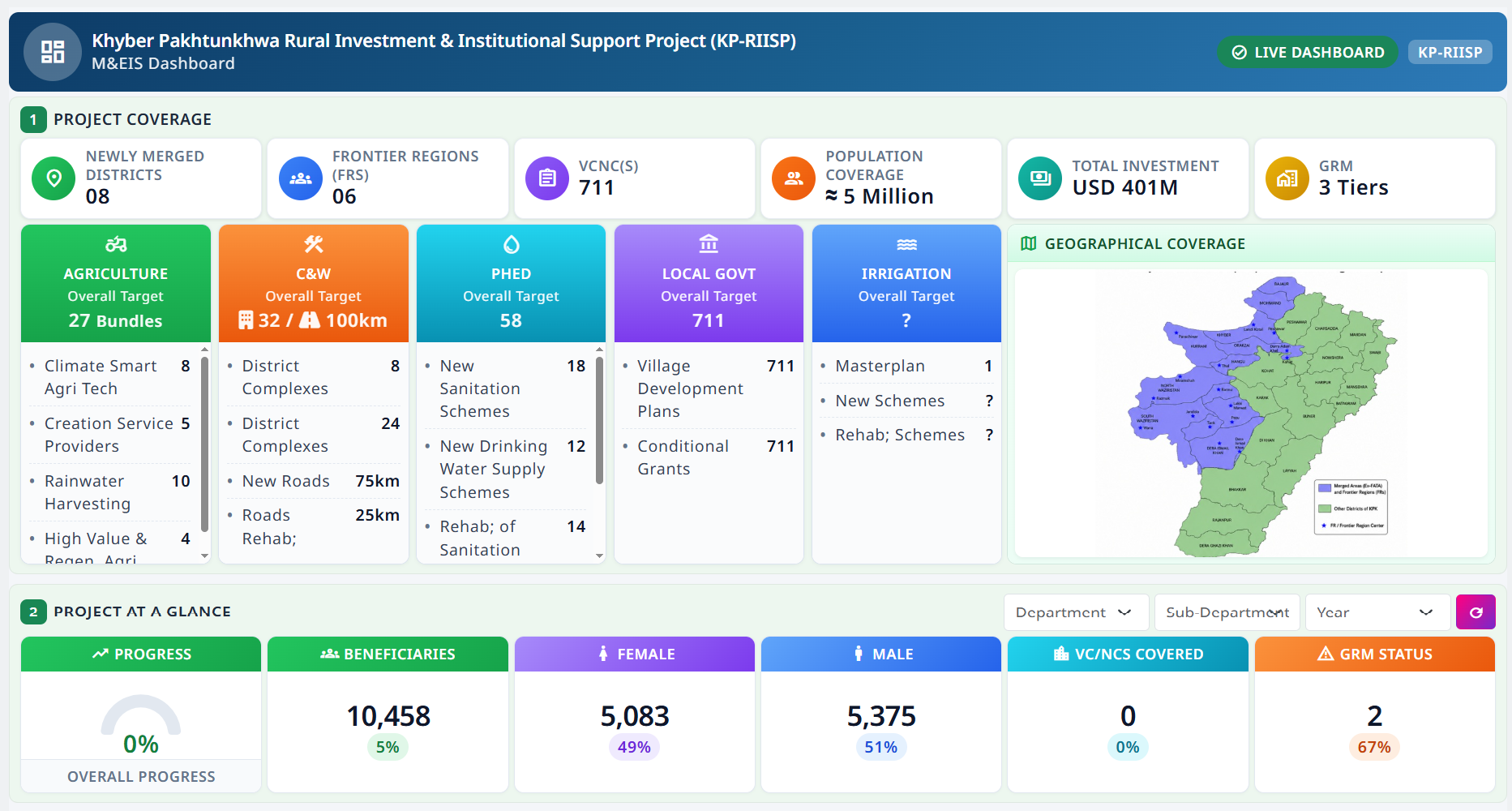 Digital M&E
Strengthening state systems, improving service delivery, and accelerating climate resilient socio-economic development in the merged districts and FRs
.jpeg) World Bank Supported
World Bank Supported
Sq. Km Coverage
Population Served
Rural Population
Newly Merged Districts
Frontier Regions
Village / NC Councils
The Khyber Pakhtunkhwa Rural Investment and Institutional Support Project (KP-RIISP) is a flagship initiative aimed at enhancing rural connectivity, improving community access to basic services, and strengthening institutional capacity for sustainable and climate resilient rural development in the newly merged districts (NMDs) and erstwhile frontier regions (FRs) of the Khyber Pakhtunkhwa province. The Project is multi-dimensional in nature—covering agriculture productivity enhancement, infrastructure development, institutional strengthening, and community participation with cross-cutting themes of inclusiveness/gender participation and environmental and social safeguards compliance
Integrated investments and institutional reforms across merged areas of Khyber Pakhtunkhwa.
KP-RIISP integrates environmental sustainability, social safeguards, and Human-Centered Design (HCD) for inclusive, transparent, and climate-resilient implementation aligned with the World Bank ESF.
Risk management, labor safety, land management & stakeholder engagement.
Community participation, third-party verification & accessible grievance systems.
Inclusion of women, persons with disabilities & marginalized groups.
Co-design of tools, user validation & conflict-sensitive implementation.
Five provincial departments delivering multisector investments and institutional development across NMDs and FRs.
Visual highlights from KP-RIISP interventions across merged districts.
.jpeg)
.jpeg)
.jpeg)
.jpeg)
.jpeg)
.jpeg)
.jpeg)
.jpeg)
.jpeg)
.jpeg)
.jpeg)
.jpeg)
.jpeg)
.jpeg)
.jpeg)
.jpeg)
.jpeg)
.jpeg)
.jpeg)
.jpeg)
.jpeg)
.jpeg)
.jpeg)
.jpeg)
.jpeg)
.jpeg)
.jpeg)
.jpeg)
.jpeg)
.jpeg)
.jpeg)
.jpeg)
.jpeg)
.jpeg)
.jpeg)
.jpeg)
.jpeg)
.jpeg)
.jpeg)
.jpeg)
.jpeg)
Monitor implementation, KPIs, PIU performance, finance, GRM, and location-wise coverage across all project components.
Planning & Development Department, Peshawar — Project Coordination & Management Unit (KP-RIISP)
KP-RIISP is a flagship development initiative designed to support integration and sustainable development of Eight Newly Merged Districts (NMDs) and Six Frontier Regions (FRs). It complements the Government's Tribal Decade Strategy.
The project strengthens public institutions, improves service delivery, expands infrastructure, and promotes inclusive socio-economic and climate-resilient development.
KP-RIISP adopts an integrated, citizen-centric approach combining institutional reforms with strategic infrastructure investments.
Duration: Eight years (2023–2031) — building state systems for merged areas.
The KP-RIISP Dashboard is a centralized digital platform capturing project implementation, performance, and results across all components.
Component A supports strategic infrastructure investments to improve access to essential public services in NMDs.
Key sectors: water supply & sanitation, rural roads, agriculture, irrigation, and administrative infrastructure — improving connectivity, productivity, and service delivery.
Component B strengthens local governance through VC/NC capacity building, community-driven development, conditional grants for local infrastructure, and public service delivery centres.
Component C supports flood recovery, rehabilitation, and climate-resilient reconstruction of flood protection infrastructure, integrated water resources management, and priority flood mitigation.
Component D strengthens coordination, M&E, digital reporting, technical assistance, capacity building, and strategic studies for results-based management.
Component E provides flexible financing for rapid reallocation of resources to support emergency response, recovery, and reconstruction after eligible disasters.
Climate-resilient infrastructure managed through ESMF, environmental screening, ESMPs, and IEE/EIA per GOP regulations and World Bank ESF.
Integrates technology, stakeholder engagement, and field realities for M&E, reporting, and Third-Party Verification.
Accessible feedback systems encouraging participation of women, youth, and vulnerable groups.
Inclusive participation and equitable access to project benefits for women, persons with disabilities, and marginalized groups.
PHED improves access to safe drinking water and sanitation in NMDs through climate-resilient infrastructure.
Agriculture enhances productivity, food security, and rural livelihoods through mechanization, value addition, and climate-smart practices.
Irrigation improves water resource management and flood resilience through the Water Sector Development Plan and priority schemes.
C&W strengthens state presence through climate-resilient administrative complexes and rural roads.
LGE&RDD strengthens 711 VC/NCs through participatory planning, conditional grants, and social accountability.